Loop Island
A 2nd-grade sandbox for feedback loops — built pedagogy first, then the world, in that order and on purpose.
Four machines. Every one of them is doing something over and over.
What this is
The experiment
Andrej Karpathy gave a model the first paragraph of The Lord of the Rings, a 1M-token budget, and asked for a three.js render. Cara Engelbrecht ran the same shape at a preschool letter-A world, and named what was missing:
“almost no product or pedagogy direction” … “I'm super curious to try with proper product spec and educational guidance.”
This is that try, at feedback loops for 7-year-olds. The design notes were written before any code, and — importantly — they record a falsifiable prediction about what backwards design would reach that free association would not.
The idea
Stripped to what fits a 7-year-old
A loop is when what you do comes back around and changes what you do next. Two flavors, and only two:
Loops that push back
Go too far and it pulls you home.
Thermostat · a full cup · your body sweating
Loops that pile on
A little more makes even more, and more.
Snowball · microphone screech · a rumor · a fire
Not “negative feedback” and “positive feedback.” Those words run backwards from a child's intuition — positive sounds good, and it's the one that burns your house down.
Backwards design
Four machines, four outcomes
Each machine exists to serve one outcome, and that link lives in the code — an activity cannot be added here without naming what a child could do because of it.
| Machine | Outcome it serves | Loop |
|---|---|---|
| 🏠 The Warm Hut | Point at a loop and say what comes back around | pushes back |
| 🔥 The Hungry Campfire | Tell pushing back from piling on | piles on |
| 💧 The Patient Pond | Say what a loop is trying to keep true | pushes back |
| 🗼 The Lighthouse | Change what a loop wants and predict what happens | pushes back …and you can move the goal |
The prediction
Recorded before building, so it could be wrong
Association would generate a thermostat and a snowball, because those are what “feedback loop” is associated with. It would be unlikely to generate changing the setpoint, because nothing about the phrase “feedback loop” suggests it. But it's the outcome that matters most.
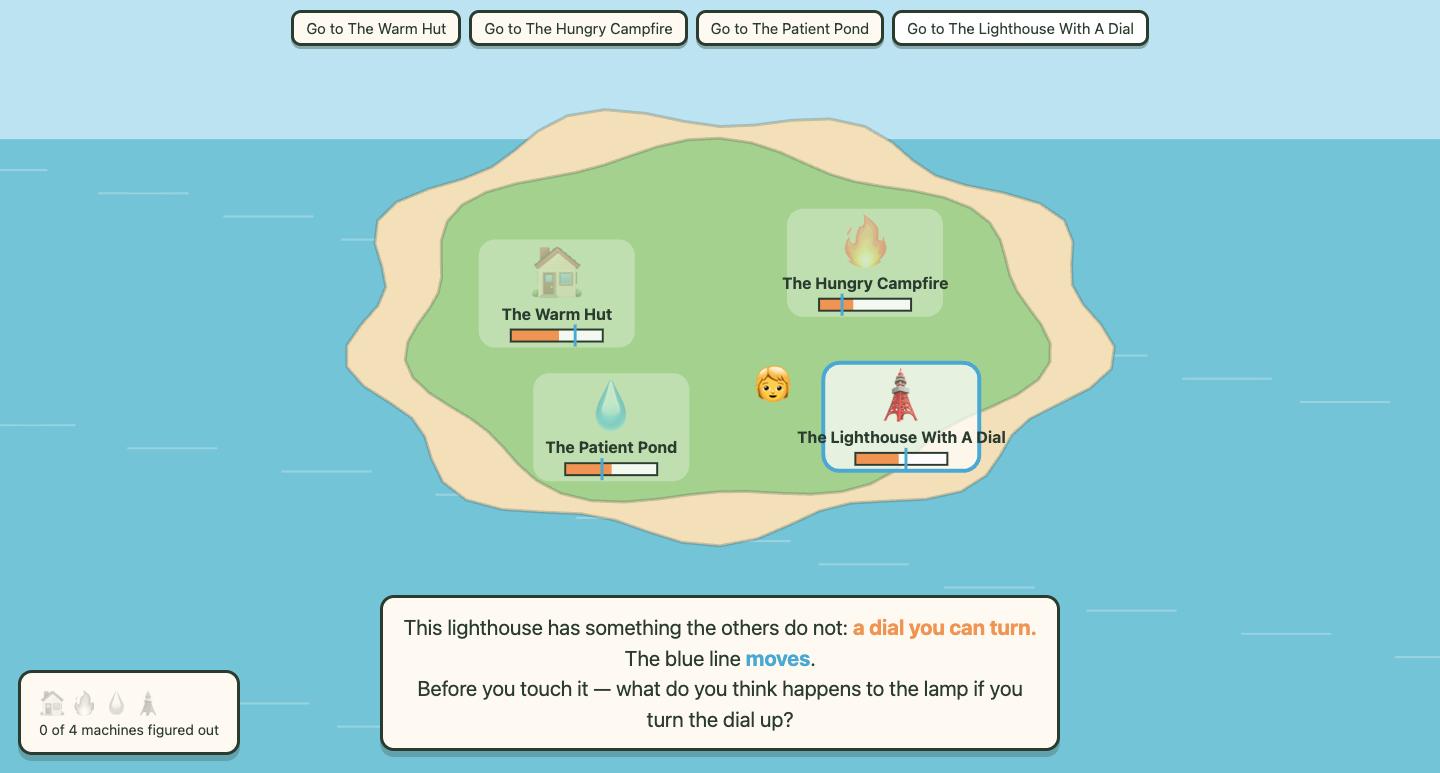
The lighthouse is that outcome — the only machine whose goal a child can move. The game asks them to predict before they touch it.
“You did not make the lamp brighter — you changed what the lamp wants, and the loop did the rest.”
That is the moment a child stops being inside a loop and starts being able to look at one from outside.
The interesting failure
An hour debugging a working app
Playing the pond lesson, nothing happened. A dozen rounds of fixes followed — hit radius, draw box, pixel conversion, cache headers, a real circular import, a real temporal-dead-zone bug. None of it worked.
Then a bare listener was armed on the canvas and clicked:
Zero. The click tool had stopped delivering events to the page. The world was never broken. Every fix “didn't work” for a reason that had nothing to do with the fix.
Karpathy's closing point is that models “can't easily audit their work because they aren't able to efficiently and natively perceive videos or play games within them.” This hit that wall in the most literal way available: there was no way to tell “my click missed” from “my click was never sent.”
Three of those dozen changes were real bugs worth keeping. Two were fixes to nothing. The remedy is now a test that runs first and fails loudly if clicks aren't reaching the canvas — so no future session spends an hour reading a dead instrument as facts about the world.
Verification
Tests that hold the design honest
18 headless tests cover the loop physics and — more interestingly — the design itself:
- Every outcome has a machine, and every machine serves a real outcome.
- The sorting deck is balanced, so guessing one pile is not a strategy.
- At least half the deck comes from an island the child already walked.
- The lighthouse is the only machine whose goal a child can move.
- No machine sits in the path between two others.
npm test      # 18 green
npm run play  # walk the world in a terminal
Sibling
The same method, a different subject
Feelings Island
A preschool sandbox for social-emotional learning. Six outcomes, and a self-report fence enforced in code — because a game must never tell a four-year-old that their own feeling is wrong.
Honesty
Known limits
- Not tested with actual 2nd graders.
- This is a prompt experiment, preserved as built. It has deliberately not been polished after the fact — doing so would contaminate what the experiment was measuring.